
Guiding Local Innovators in Medical Devices:
Step 1 - Regulatory Guidance - Health Canada
Regulatory Guidance - Health Canada
In this step:
Provincial Research and Development Support for Innovators
For a comprehensive collection of provincial regulatory, quality, commercialization and development supports for innovators, please utilize the Alberta Assets tool.
Health Canada and Medical Devices: Investigational Testing Authorizations
Medical Devices Directorate (MDD):
The MDD is the office within the Therapeutic Products Directorate (TPD) that regulates medical devices, including applications for Investigational Testing Authorizations (ITAs). An ITA is required when a non-approved medical device is undergoing testing to assess safety and efficacy.
In Canada, Sponsors or Manufacturers should submit an ITA to use unapproved devices in clinical trials to the Device Evaluation Division of the Medical Devices office of Health Canada.
Clinical trials for medical devices are not classified by phased development as with drugs (i.e., Phase I – IV clinical trials). Instead, trials are typically called pilot and pivotal studies.
When is an ITA required?
- For all unlicensed class II, III, and IV medical devices (as defined under the Food and Drugs Act) that will be imported and/or sold in Canada for the purpose of investigational testing involving humans.
- An ITA is required for investigator-initiated trials that involve an unlicensed device. In these cases, the investigator must obtain the cooperation of the manufacturer, who must be the official applicant and signatory for the ITA application.
- A licensed device to be used in a manufacturer‐sponsored study intended to generate data to support a new indication for use will require an ITA application.
- Licensed medical devices used in clinician‐sponsored investigations that are not initiated by the manufacturer and are not intended to generate data to support a licensing application now require an ITA.
- Class I medical devices do not require ITAs, but must still comply with safety, efficacy, and quality standards.
Health Canada’s target review time for an ITA is 30 calendar days. If the ITA is approved, an NOL will be sent to the sponsor indicating study go-ahead pending REB approval.
For further detailed guidance, visit Health Canada’s Guidance Document: Applications for Investigational Testing Authorization for Medical Devices.
ITA Application Package
Appendix 4 of Health Canada’s Guidance Document: Applications for Investigational Testing Authorization thoroughly outlines the required content and structure of the ITA submission package. Section 2.3.5 of the same guidance document summarizes the submission requirements for each device class in Table 1.
Medical Device Classification
Health Canada regulates medical devices under a risk-based system and uses several factors to determine the classification, including:
- Intended use (therapeutic vs. diagnostic vs. monitoring)
- Duration and nature of body contact
- Mechanism of action
- Invasiveness
- Other specific claims or representations made by the device manufacturer
For example: Class I devices are typically non-invasiveness devices, Class II devices require some level of regulatory control, Class III devices are often devices that support or sustain human life, and Class IV devices are potentially implanted and/or pose significant risk to health. Higher-class medical devices require increased regulatory, evidence and quality management requirements.
Examples:
Class I: Bandages
Class II: Contact lenses, catheters
Class III: Orthopaedic implants, glucose monitors, diagnostic ultrasound systems
Class IV: Pacemakers, HIV test kits, angioplasty catheters
Information to assist with medical device classification can be found in the Medical Device Regulations, which outline the Classification Rules, as well as in various Health Canada guidance documents:
- Guidance Document: Guidance for the Risk-based Classification System for In Vitro Diagnostic Devices (IVDDs) – Canada.ca
- Guidance Document – Guidance on the Risk-based Classification System for Non-In Vitro Diagnostic Devices (non-IVDDs) – Canada.ca
- Guidance for Industry- Keyword Index to Assist Manufacturers in Verifying the Class of Medical Devices – Canada.ca
Manufacturers may contact the Investigational Testing division of Health Canada for additional guidance, and to determine whether an ITA application is required at: it-ee@hc-sc.gc.ca.
For assistance in navigating Health Canada Device Classification and submissions, please connect with provincial supports such as:
IMPACT Regulatory and Clinical Development
For a comprehensive collection of provincial regulatory, quality, funding, commercialization, and development supports for innovators, please utilize the Alberta Assets tool.
Health Canada Pre-ITA Meetings
Health Canada encourages sponsors to request a pre-ITA consultation meeting. These meetings are particularly useful for applications that may include new or complex issues that require further guidance from Health Canada. These meetings provide an opportunity to receive advice directly from Health Canada on potential gaps or product development concerns.
Requests for a consultation meeting or pre-ITA application meeting should be submitted in writing by the manufacturer or importer to the Investigational Testing Division of the Medical Devices Bureau at: it-ee@hc-sc.gc.ca. Researchers involved in the study may also participate.
Visit section 2.2 of Health Canada’s Guidance Document: Applications for Investigational Testing Authorization for Medical Devices to find detailed information on the information package required for pre-ITA meetings.
Applicable Health Canada Documents & Resources
Document or Resource | Governing Body & Use |
Guidance for determining medical device application type: Overview – Canada.ca | Health Canada: Determining regulatory application type for medical device |
Guidance on clinical evidence requirements for medical devices: Overview – Canada.ca | Health Canada: Guidance document on clinical evidence requirements for medical devices |
Health Canada: Guidance document for submitting an ITA to Health Canada | |
Health Canada: Comprehensive guide, outlines classification rules for devices | |
Health Canada: Guidance document for IVDDs | |
Health Canada: Guidance document for non-IVDDs | |
Health Canada: document to clarify how SaMD fits into Health Canada’s regulatory framework for devices | |
Health Canada: used alongside the regulations to verify device classification | |
Health Canada: General overview of medical device regulation in Canada | |
Guidance Document: Software as a Medical Device (SaMD): Classification Examples – Canada.ca | Health Canada: SaMD Classification examples, useful walkthroughs |
Guidance on how to complete the application for a new medical device licence: Overview – Canada.ca | Health Canada: Guidance on completing an application for new medical device license (post-clinical trials) |
Guidance on medical device establishment licensing (GUI-0016): Overview – Canada.ca | Health Canada: Outline of licensing requirements for MDELs, including who requires an MDEL |
Regulatory Guidance - FDA & EMA
In this step:
- Medical Devices & the FDA
- FDA Medical Device Classification
- Automatic Class III Designations
- Premarket Submission Pathways & Clinical Testing Required
- Premarket Approval Pathway & Clinical Trials
- IDE Decision Tree
- Medical Devices in the EU
- Comparing Device Classifications: FDA, EMA and Health Canada
- Applicable Documents & Resources (FDA & EMA)
Medical Devices & the FDA
Medical devices are subject to unique requirements to enter the U.S. market. Rather than just demonstrating safety and efficacy, the Food and Drug Administration (FDA) requires innovators to prove substantial equivalence to existing devices (the 510(k) route) OR provide rigorous clinical data demonstrating safety and effectiveness (the premarket approval route). The correct regulatory pathway for your device, which dictates required clinical testing, evidence requirements, budget and timeline, is driven by medical device classification.
FDA Medical Device Classification
Medical device classification in the US is determined by the device’s intended use and associated risk level under 21 CFR Parts 862-892. The FDA has established classifications for over 1700 different types of devices and further grouped them into 16 medical specialities referred to as panels.
The 3 regulatory device classes are based on the level of control necessary to assure the safety and effectiveness of the device. Two similar devices may be classified differently depending on intended use or patient contact. As device class increases from I to III, the regulatory controls also increase- the correct premarket submission route is determined by device classification.
- Class I (low risk) – e.g., tongue depressors, elastic bandages, exam gloves. Most are exempt from 510(k); only registration + listing required.
- Class II (moderate risk) – e.g., powered wheelchairs, infusion pumps, surgical drapes. Usually require 510(k) clearance demonstrating substantial equivalence to an existing device.
- Class III (high risk) – e.g., pacemakers, heart valves, implantable defibrillators. Require Premarket Approval (PMA) supported by extensive clinical data.
Key Considerations for Innovators:
- What is the intended use of my device?
- What level of risk does my device pose to patients?
- Is there an existing device like mine already on the U.S. market?
How Do I Classify My Device?
- Search the FDA’s Product Classification Database to find a predicate device (if there is one available). Here, innovators will most likely be able to identify the correct submission type.
- If your device will be considered novel, utilize the FDA Q-submission program to discuss classification with the regulatory body earlier on and at no cost.
For further detailed guidance, visit the FDA’s classification page: Classify Your Medical Device | FDA
For assistance in navigating FDA Device Classification and submissions, please connect with provincial supports such as:
IMPACT Regulatory and Clinical Development
For a comprehensive collection of provincial regulatory, quality, funding, commercialization, and development supports for innovators, please utilize the Alberta Assets tool.
Automatic Class III Designations
The FDA’s De Novo classification pathway is an option available for novel medical devices, which logically do not have a legally marketed predicate to base a 510(k) submission on.
Not all novel medical devices have the same inherent level of risk; however, all novel medical devices are automatically assigned a Class III designation by the FDA, which requires the device to follow the PMA approval pathway. To prevent the PMA submission route requirements, it is up to the sponsor to prove that their novel medical device deserves a lower risk classification, thus a lower burden path to market.
Eligible devices can be classified as Class I or II when the sponsor submits a De Novo request and shows a reasonable assurance of safety and effectiveness through general and special controls. General controls are the FDA’s baseline requirements for medical devices, such as providing accurate labeling and following manufacturing quality requirements. Special controls are additional device-specific safeguards. If general controls alone provide reasonable assurance of safety and effectiveness, the FDA will typically designate a Class I classification. If special controls are needed, the device will typically be classified as Class II.
A De Novo request includes the device description and intended use, performance data, and labeling and manufacturing information. Bench, animal, or clinical data may be needed, depending on the device. Sponsors can submit a De Novo request directly or following a Not Substantially Equivalent (NSE) decision in a 510(k) review.
If the FDA grants the De Novo request, the device is classified as Class I or II and may serve as a predicate for future 510(k) submissions. If denied, the device remains Class III and requires the PMA submission pathway. Sponsors are encouraged to use FDA’s Pre-Submission Program to obtain feedback before submitting a De Novo request.
Sponsors are encouraged to utilize the FDA Q-submission program to obtain feedback at no cost prior to submitting a De Novo request.
Premarket Submission Pathways & Clinical Testing Required
Premarket Submission Pathway | Use Case | FDA Timeline | Clinical Testing Required |
510(k) (substantial equivalence pathway) | Used for medical devices when a suitable predicate exists, typically only with Class II devices, since Class III devices have stricter regulatory requirements and Class I devices are typically exempt from premarket submissions. | FDA goal is 90 days for review. This can be extended with additional information requests. | Typically requires bench testing & literature data to prove substantial equivalence. |
De Novo Classification Request (known as the innovation pathway) | Used for medical devices that are considered novel (no predicate exists) and are classified as low-moderate risk (class I or class II). | FDA goal is 150 days for review. This can be extended with additional information requests. | There is the potential to require limited clinical data depending on the risk level. |
Premarket Approval (PMA) | Used for medical devices that are classified as high risk/life-sustaining (class III). | FDA goal for review is 180 days, but this is often extended due to additional information requests. | Due to the level of regulatory controls, rigorous clinical testing via clinical trials is required (including applicable bench and animal testing for preclinical requirements). To run clinical trials, an Investigational Device Exemption (IDE) may be required. Utilize the FDA Q-submission program to review preclinical data & confirm if sufficient for PMA submission. |
Note: Some Class I and Class II devices are exempt from 510(k) requirements if they meet regulatory limitations (Class I exempt and Class II exempt).
Premarket Approval Pathway & Clinical Trials
The PMA submission pathway is the only available option for Class III devices (with the exception of a few alternative pathways such as the Humanitarian Device Exemption). PMA’s require extensive clinical data in the form of clinical trials. The FDA utilizes an Investigational Device Exemption (IDE) submission process for most devices that are required to run clinical trials. IDEs submitted to the FDA to receive approval to run clinical trials are reviewed within 30 days.
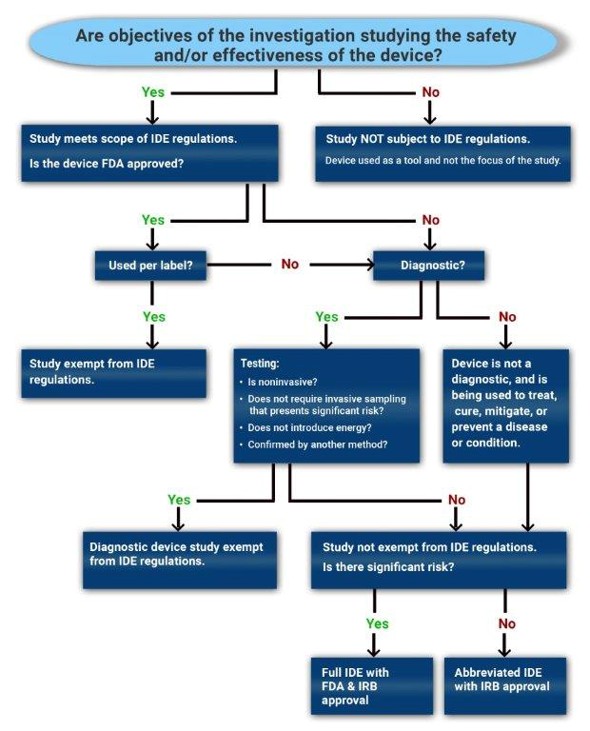
- An IDE is only required for devices that pose a significant risk (SR) to patients. For SR devices, a complete IDE needs to be submitted to the FDA, and both FDA and IRB approval is needed prior to study start. For nonsignificant risk (NSR) devices, innovators only need to obtain IRB approval before study start. An IDE is not required for commercial devices used in accordance with their labelling, diagnostic devices, and veterinary devices.
Note- an IDE submission is very similar in layout and content to a Health Canada ITA.
IDE Decision Tree
Not all medical device clinical trials are required to obtain an IDE. Utilize the NIH decision tree to determine whether a proposed clinical trial requires an IDE submission.
Medical Devices in the EU
In the EU, CE marking—not EMA approval—enables market access for medical devices, with clinical trial requirements driven by device risk, innovation level, and intended use:
- For class I (low-risk) devices, the manufacturer can self-certify the compliance which applies the CE mark and market authorization.
- For class IIa, IIb and III devices, the CE marking is granted by Notified Bodies (e.g. TÜV, BSI); notified bodies are not competent authorities like the FDA or the EMA.
Notified Bodies assess and certify medical devices for compliance with EU safety and performance regulations before market entry.
Competent Authorities are national regulators that oversee and supervise Notified Bodies to ensure enforcement of EU medical device laws.
The Notified Bodies require clinical data for medical devices and do a clinical evaluation process with either: a) already existing data or b) clinical trial data/new data collected. The more innovative a medical device is, the higher the chance that a clinical trial is required.
In the EU, there are fundamentally two types of clinical trials for medical devices:
- Non-CE Devices: the purpose of these studies is to demonstrate performance, usability and safety. These studies require approval from national Competent Authorities in the EU Member States. These Competent Authorities do not grant market approval but are responsible for approving the medical device trials.
- Devices with a CE Mark (Post-Market Clinical Follow-up): these studies are utilized when the safety and performance of a device has already been established in some manner; for example, through the clinical evaluation of data from an equivalent medical device. If this evaluation led to a CE marking of the device, a post-market study is usually needed. These studies typically do not require approval from the Competent Authorities and instead only need ethics committee approval. If the risk or intended use of the device changes in these post-market studies with a CE marked device, the regulatory path changes to a non-CE marked route and Competent Authority approval is required.
Comparing Device Classifications: FDA, EMA and Health Canada
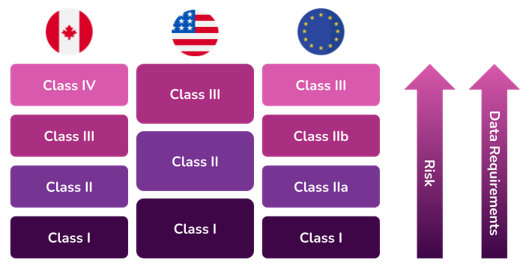
As the risk of the medical device increases, so do the data requirements from each of the regulatory agencies. A simple comparison across the FDA, EMA and HC regulatory bodies outlines how the medical device classifications align with each other across the different agencies.
For support in other global jurisdictions, please contact the Trade Commissioners Office.
Applicable Documents & Resources (FDA & EMA)
Document or Resource | Governing Body & Use |
FDA: Device Classification | |
The 510(k) Program: Evaluating Substantial Equivalence in Premarket Notifications [510(k)] | FDA: Document to assist in determining regulatory strategy route |
FDA: Very useful video to assist in device classification and regulatory strategy (de novo process vs. PMA vs. 510(k)) | |
FDA: Product Classification Database (useful to scan related products to determine substantial equivalence) | |
FDA: Device Classification Panels (“panels” are groups of prior classified devices and include cardiovascular, anesthesiology, etc.) | |
FDA: Premarket Approval for Class 3 Medical Devices, the most stringent regulatory category | |
De Novo Classification Process (Evaluation of Automatic Class III Designation) | FDA | FDA: Route to prepare a De Novo request for a device automatically assigned a Class III designation due to no available predicate device. |
FDA: Document to assist in submitting an IDE, a regulatory submission that allows for the clinical investigation of a medical device. | |
In Vitro Diagnostic (IVD) Device Studies – Frequently Asked Questions | FDA | FDA: Guidance document to assist innovators in determining if an IDE is required for their diagnostic device. |
FDA: Information on the FDA Q-submission program, which allows innovators to discuss clinical trial design with the FDA; feedback is typically given within 75 days. | |
FDA: Submission and FDA fees | |
FDA: Simple overview of medical device submissions and market entry. | |
Electronic Submission Template for Medical Device De Novo Requests | FDA | FDA: Submission template for De Novo Requests |
FDA: FAQ document for the clinical data requirements in medical device applications | |
FDA: The QMSR governs how you manufacture, test, and distribute your medical device (GMP) | |
Guidance – MDCG endorsed documents and other guidance – Public Health | EMA: A grouped resource of guidance documents on applying the Medical Device Regulations in the EU, from the Medical Device Coordination Group (MDCG) |
Preclinical Device Testing & Design Standards
In this step:
Important ISO Standards for Medical Devices
ISO 13485: This ISO standard addresses quality management in the medical device industry and outlines the comprehensive requirements for a Quality Management System (QMS). Overall, ISO 13485 can assist innovators in identifying and mitigating risks associated with the design, development, and production of medical devices.
ISO 14155: This ISO standard addresses good clinical practice for the design, conduct, recording and reporting of clinical investigations carried out in human subjects to assess the clinical performance or effectiveness and safety of medical devices.
There are many standards impacting medical devices; Health Canada provides a useful list of recognized standards for medical devices, accessed at this link: List of recognized standards for medical devices – Canada.ca
There are also medical device guides available for purchase from ISO, which bundle many useful ISO standards together. ISO – ISO 13485:2016 – Medical devices – A practical guide
Critical Device Testing
Since medical devices can have local and systemic effects on biological systems, specific biocompatibility endpoints must be addressed in preclinical studies, such as:
- Systemic toxicity based on ISO 10993-11
- Hemocompatibility based on ISO 10993-4
- Implantation/local tissues effects based on ISO 10993-6
Preclinical testing endpoints in the 10993 series should be selected based on the nature, duration, and anatomical location of body contact.
In addition to these broad “horizontal” biocompatibility standards applicable to all medical devices, innovators should confirm if there are any applicable “vertical” device-specific ISO standards, ASTM standards or regulatory guidance.
For example, cardiac valve testing is discussed in ISO 5840, while ASTM F2901-19 outlines tests to evaluate the potential neurotoxicity of medical devices. These vertical standards can assist innovators and are very useful when designing the device model and preclinical studies.
For assistance in navigating preclinical testing and ISO Standards, please connect with provincial supports such as:
IMPACT Regulatory and Clinical Development
For a comprehensive collection of provincial regulatory, quality, funding, commercialization, and development supports for innovators, please utilize the Alberta Assets tool.
Digital Health & SaMD
In this step:
SaMD Considerations and Classification Process
Software plays an increasingly important role in healthcare and is a large component within healthcare innovation. Software as a Medical Device (SaMD), as defined by the International Medical Device Regulators Forum (IMDRF), is software that performs one or more medical purposes and operates independently of dedicated medical-device hardware. Once software is confirmed as medical device, it can be considered a medical device in all regards, and all of the relevant medical device regulations apply to that software.
For innovators, determining whether their software meets this definition is a critical first step because it establishes whether medical device requirements apply and which regulatory pathway must be followed. If the intended use of the software includes the medical purposes defined in the Food and Drugs Act, such as:
- diagnosis
- treatment
- monitoring
- prevention
- support for clinical or patient management,
the software automatically classifies as a medical device. Software used only for storage, transmission, display, administration, or general wellness may fall outside medical device regulation if it does not drive medical decision-making.
SaMD also needs to be risk classified by regulators, the same as all other medical devices. Risk classification determines necessary regulatory requirements, including clinical trials. Regulators utilize modified version of the IMDRF SaMD risk categorization matrix. The risk categories are determined by assessing both the significance of the software output and the seriousness of the healthcare situation. SaMD may inform clinical management, drive clinical management, or treat/diagnose; the healthcare situation may be non-serious, serious, or critical, resulting in progressively higher risk classification. Together, these factors determine the applicable risk category and medical device class, from Class I to Class IV.
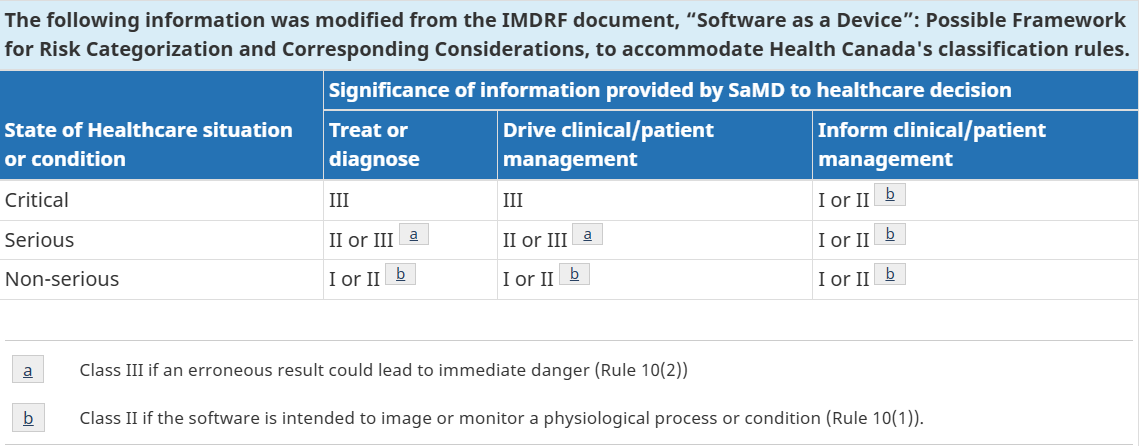 Guidance Document: Software as a Medical Device (SaMD): Definition and Classification
Once the software is classified as a medical device and has a risk classification (Class I-IV), the appropriate medical device regulations apply (ex. IVDD, non-IVDD guidance documents). IVDD SaMD explicitly uses the IVDD classification guidance from Health Canada.
Health Canada has created a helpful guidance document with SaMD classification examples for further exploration.
IEC Scope Expansion 62304 and AI/ML
Artificial intelligence (AI) and machine learning (ML) are transforming the medical device landscape by enabling innovative approaches to health technology. The FDA has authorized more than 1,000 AI/ML-enabled medical devices, reflecting substantial growth in recent years. Because these technologies can learn from and adapt to new data, they create distinct regulatory challenges, and the regulatory framework continues to evolve to support innovation while ensuring safety and effectiveness. Established software lifecycle standards are undergoing significant revisions that innovators need to consider during development of AI/ML-enabled medical devices.
A critically important standard is IEC 62304, the international standard for medical device software life-cycle processes, and defines the processes, activities, and tasks for developing safe software. IEC 62304 applies to both standalone SaMD and embedded software.
IEC 62304 is undergoing a large revision and scope expansion. Software that supports health workflows or uses health data, such as clinician dashboards and remote monitoring platforms, may fall under this scope expansion, planned for 2028/2029.
The planned IEC 62304 revision expands coverage beyond traditional devices to include specific content for AI/ML-driven health software and introduces a dedicated AI/ML development lifecycle with explicit governance. There will be stronger expectations around the planning, validation, and performance changes for AI/ML health software.
Additionally, Edition 2 of IEC 62304 is integrating cybersecurity more directly into lifecycle processes of medical device software, and will be treated as a design control concern. Innovators may need to show cybersecurity considerations throughout development.
For assistance in navigating the upcoming IEC 62304 revision and scope expansion, please connect with provincial supports such as:
IMPACT Regulatory and Clinical Development
For a comprehensive collection of provincial regulatory, quality, funding, commercialization, and development supports for innovators, please utilize the Alberta Assets tool.
GMP & Device Design
In this step:
GMP Considerations for Medical Devices
Good Manufacturing Practice (GMP) considerations for medical devices are closely connected to internationally recognized quality management expectations, particularly ISO 13485. This standard outlines the requirements for a Quality Management System (QMS) in the medical device industry and supports manufacturers in establishing documented procedures, resource controls, and continuous improvement practices across the device lifecycle.
In practice, GMP and ISO-aligned systems help innovators identify, evaluate, and mitigate risks associated with the design, development, production, distribution, servicing, and post-market monitoring of medical devices. GMP requirements include:
- Quality Management Systems
- Personnel Considerations (training, etc.)
- Facilities and Equipment (machines calibrated, etc.)
- Design and Document Controls (maintaining accurate records)
- Production and Process Controls (ensure consistent production)
There are many standards that impact medical devices, and Health Canada provides a helpful list of recognized standards for manufacturers and innovators to reference. The Medical Devices Regulations outline several key considerations depending on the class of the device as well as importer and distributor requirements.
For assistance in navigating GMP standards and understanding recent changes, please connect with provincial supports such as:
IMPACT Regulatory and Clinical Development
For a comprehensive collection of provincial regulatory, quality, funding, commercialization, and development supports for innovators, please utilize the Alberta Assets tool.
Design Controls
For certain medical devices, 21 CFR 820.30 requires a structured and documented design control process maintained in a Design History File (DHF). Prior to chronic animal or GLP studies, the device should be under design freeze, meaning the design is finalized and representative of the intended marketed product, with any subsequent changes formally controlled and documented.
DHF’s are almost always reviewed during regulatory audits, and poor design controls are routinely a top regulatory compliance finding in the U.S and Canada. Detailed information can be found here: 21 CFR § 820.30 – Design controls. – Content Details – CFR-2023-title21-vol8-sec820-30
Medical Device Licensing
Medical Device Licensing: MDL and MDEL
Health Canada issues 2 different types of licenses for medical devices:
- A medical device establishment license (MDEL) is a license issued to Class I manufacturers as well as importers or distributors of all device classes to permit them to import or distribute a medical device in Canada. Overall, an MDEL is issued to the company rather than to a product and demonstrates that the organization is authorized, compliant and able to handle medical devices within Canada.
- Medical Device License (MDL): an MDL is issued for the medical device itself and applies to Class II, III, and IV devices. Before granting an MDL, Health Canada reviews the device’s safety, effectiveness and quality to ensure it meets regulatory and performance standards in Canada. An MDL authorizes manufacturers of Class II, III, IV devices to import or sell within Canada.
Many innovators will require both an MDL and an MDEL- for example, if a company/innovator manufactures a Class III device and wishes to distribute it in Canada, the MDL would cover product approval while the MDEL would cover the operational compliance.
Beyond Regulatory Requirements
In this step:
Study Design and Protocol Development
A study protocol describes in detail the plan for your study including the objectives, study design, methodology, data management and analysis plan, timelines and budget.
Complete outlines of study designs and trial protocols are required for pre-CTA, pre-ITA and Q-submission meetings with regulatory authorities. At this stage, it is critical to consider the number of participants required and where they will be enrolled. The SPIRIT-CONSORT guidelines are a useful tool that outline standard protocol items in interventional clinical trials.
There are numerous clinical trial design and protocol development services available to Alberta-based innovators. Connect with the Alberta Assets tool for more information.
Intellectual Property Considerations
Often the cornerstone of a company’s value, IP is typically protected through patent, copyright, or trademark applications, although the necessity and cost-effectiveness of such protection can vary.
It’s advisable for innovators to develop a structured IP strategy to guide future business decisions, including the timing of IP protection efforts. If you are within an Alberta institution, connect with your appropriate innovation offices to discuss protecting your innovation and developing a robust business strategy.
There are numerous IP supports and services available to Alberta-based innovators. Connect with the Alberta Assets tool for more information.
In addition, Alberta Innovates has published an applicable Health Innovation Roadmap that outlines key milestones in different domains along the development and commercialization journey, including IP milestones.
Clinical Trial Funding
Please utilize the Alberta Assets tool for a comprehensive list of clinical trial funding opportunities for both academic and non-academic innovators.
Health System Adoption
Although understanding the regulatory pathway for your innovation is critical, success also depends on adoption of your innovation within the health system. Clinical evidence alone isn’t sufficient for health system adoption. Important considerations include:
Define the system problem and fit: Clearly define the care or evidence gap, impacted population, current standard of care, and how the technology aligns with the provincial health agency priorities.
Value and affordability: Decision makers will look for evidence of improved outcomes, quality, access, provider experience, efficiency, cost savings, cost avoidance, or return on investment.
Identify the right health system partners: Engage clinical champions, operational sponsors, patients/families, procurement advisors, and the relevant provincial health agency.
Build the adoption evidence package: Combine clinical trial evidence with health economic analyses, real-world evidence, usability, workflow fit, implementation evidence and outcomes that matter to local decision makers.
Test in a real-world setting: Pursue a pragmatic or pilot trial, implementation study, or health evidence review to demonstrate feasibility, impact, safety, and value in Alberta care settings.
Implementation readiness: Adoption depends on fit with clinical workflows, staffing, training, change management, service delivery models, maintenance, and support.
Please refer to the Health Innovation Roadmap provided by Alberta Innovates. This roadmap outlines key milestones, including considerations for health system adoption and product-market fit.
Connect with the Health System Innovation and Partnerships team at Alberta Innovates for assistance with health system adoption.
Ready to Run Your Trial?
In this step:
CROs and Vendors
Are you ready to run your clinical trial? It’s time to think about CROs and vendors.
What is a Contract Research Organization (CRO)?
A CRO provides outsourced research and clinical trial services to clinical trial sponsors, including start-ups. These services can be all or a part of the clinical trial process, such as:
- Preclinical studies
- Regulatory strategy and regulatory submissions
- Quality management and ICH-GCP compliance
- Site selection, study start-up, study monitoring and study close-out
- Clinical trial management, ethics submissions, safety reporting, record keeping, DSMBs, overall data management
- Post-market surveillance
What is a clinical trial vendor?
A vendor is a specific service provider that specializes in a specific area of clinical trial operations, such as central labs, training, or translation services. Vendors can be contracted by the sponsor to perform their designated services or may be hired directly by the CRO. Sometimes, vendors are embedded into the CRO teams.
Clinical Trial Offices: Support Services
Academic innovators and SMEs not affiliated with an institution can access the support services from the U of A and U of C clinical trial offices (CTOs). The CTOs can assess readiness and help review what clinical trial services are needed and directly offer services; they can also assist with a general strategy, including assistance with vendor selection.
Alberta-based supports and services such as Applied Pharmaceutical Innovation or IMPACT Regulatory and Clinical Development can offer consultancy to determine what CRO services you need, what capabilities you have in-house, and compare against what they can offer as a CRO or what other provincial supports can offer.
Reach out to Clinical Trials Alberta for additional support and guidance along your clinical trial journey.