
Guiding Local Innovators in Therapeutics:
Step 1 - Preclinical Testing & ICH Guidelines
Preclinical Testing & ICH Guidelines
In this step:
Preclinical Testing
Preclinical studies evaluate a drug/device candidate’s safety and biological effectiveness before human testing using in-vitro, in-vivo, ex-vivo, and in-silico models. These studies generate reliable data on toxicity, safety, pharmacokinetics, and pharmacodynamics using models relevant to the intended human population.
Preclinical studies are governed by a range of international frameworks, including:
- GLP requirements under the Code of Federal Regulations (21 CFR Part 58)
- Preclinical studies are aligned with ICH M3 guidelines
- Preclinical results are typically documented within Common Technical Document Module 4 to allow for harmonized electronic regulatory submissions
For assistance in navigating preclinical testing and ICH guidelines, please connect with provincial supports such as:
Applied Pharmaceutical Innovation
IMPACT Regulatory and Clinical Development
For a comprehensive collection of provincial regulatory, quality, funding, commercialization, and development supports for innovators, please utilize the Alberta Assets tool.
International Council for Harmonisation (ICH) Guidelines
ICH Guidelines are extremely useful tools for biotechnology development. The guidelines of ICH are broadly categorized into four types:
ICH Guideline Type | Content |
Chemical & pharmaceutical quality assurance | |
In-vitro & in-vivo preclinical testing | |
Clinical studies in human beings | |
Medical terminology, electronic standards and CTDs |
For Alberta-based SMEs planning preclinical testing, the ICH guidelines provide a standardized framework for evaluating preclinical safety of pharmaceuticals. These guidelines support the identification of safe dosing strategies, dose escalation schemes, target organs for toxicity, and key safety parameters for clinical monitoring. ICH S6(R1), the guideline for the Preclinical safety evaluation of biotechnology-derived pharmaceuticals is particularly relevant, with information on the selection of:
- Dose escalation schemes
- Toxicity studies, including target organs for toxicity
- Immunogenicity testing
- Selection of species
- PK studies
- Specific testing protocols for biologics
For assistance in navigating preclinical testing and ICH guidelines, please connect with provincial supports such as:
Applied Pharmaceutical Innovation
IMPACT Regulatory and Clinical Development
For a comprehensive collection of provincial regulatory, quality, funding, commercialization, and development supports for innovators, please utilize the Alberta Assets tool.
Relevant ICH Guidelines for Preclinical Testing
| Guideline Number | Title |
|---|---|
| ICH Q3A-Q3E | Impurities |
| ICH Q5A | Viral Safety Evaluation of Biotechnology Products Derived from Cell Lines of Human or Animal Origin |
| ICH S1A-S1C | Carcinogenicity Studies |
| ICH S2 | Genotoxicity Studies |
| ICH S3A-S3B | Toxicokinetics and Pharmacokinetics |
| ICH S4 | Toxicity Testing |
| ICH S5 | Reproductive Toxicology |
| ICH S6 | Biotechnological Products |
| ICH S7A-S7B | Pharmacology Studies |
| ICH S8 | Immunotoxicology Studies |
| ICH S9 | Nonclinical Evaluation for Anticancer Pharmaceuticals |
| ICH S10 | Photosafety Evaluation |
| ICH S11 | Nonclinical Paediatric Safety |
| ICH S12 | Nonclinical Biodistribution Considerations for Gene Therapy Products |
| ICH M3 | Nonclinical Safety Studies |
| ICH M6 | Gene Therapy |
| ICH M7 | Mutagenic Impurities |
Useful Regulatory Links for Preclinical Testing
The Quality Overall Summary-Chemical Entities is a template offered by Health Canada. This template can be compared against preclinical data to ensure completeness of the preclinical testing portfolio prior to Phase 1 CTA submission to Health Canada. These templates exist for Phase 2 and Phase 3 CTAs as well. |
Experimental Design Assistant (EDA) is a free resource provided by the NC3Rs. The EDA helps you build a diagram representing your experimental plan, which can be critiqued by the system to provide feedback. |
Validity Checklist for in vivo Efficacy Studies is a checklist to assist researchers and others in determining whether a given experiment(s) has addressed factors that threaten the reliability and clinical generalizability of study findings. |
eCFR :: 21 CFR Part 58 — Good Laboratory Practice for Nonclinical Laboratory Studies is a Code of Federal Regulations document that outlines GLP practices for nonclinical laboratory studies intended to support regulatory applications for clinical trials. |
Guideline on Requirements for First-in-Man Clinical Trials for Potential High-Risk Medicinal Products is an EMA guideline intended to assist innovators on the preclinical data requirements for high-risk first-in-man clinical trials. |
Guideline on strategies to identify and mitigate risks for first-in-human and early clinical trials with investigational medicinal products is an EMA guideline intended to assist innovators in the transition from non-clinical to early clinical development. |
Health Canada’s guidance document on non-clinical laboratory data supporting drug product submissions, and the adherence to GLP. |
Regulatory Guidance
In this step:
- Health Canada Clinical Trial Applications
- Clinical Trial Application Process
- Clinical Trial Amendments
- Applicable Health Canada Guidance Documents (Therapeutics)
- New Drug Submissions
- FDA Investigational New Drug Applications
- Protocol Amendments & INDs
- CTA vs. IND
- EMA & EU Clinical Trials Regulation: CTIS Submissions
- Key Differences Across EU, US and Canada
Health Canada Clinical Trial Applications
When is a Health Canada Clinical Trial Application (CTA) required?
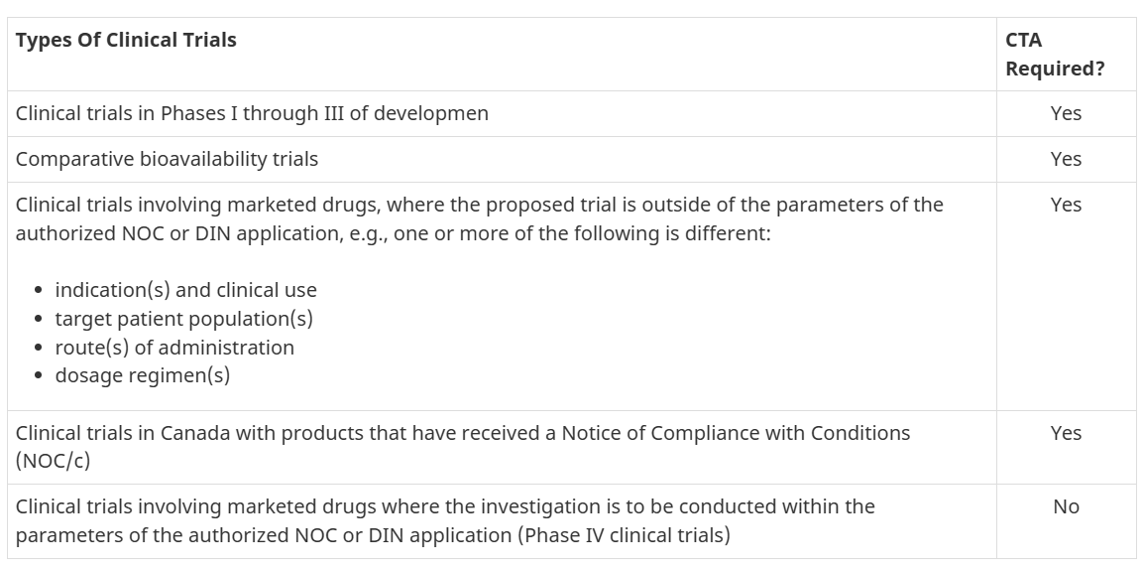
CTAs are required for clinical trials using drugs not authorized for sale in Canada, including clinical trials in Phases I through 3 of drug development and comparative bioavailability studies. This also applies to trials involving authorized drugs, where the proposed use of the drug is outside the parameters of the NOC or DIN; for example, when one or more of the following is different:
- indication and clinical use
- target patient population
- route of administration or
- dosage regimen
Not all clinical trials require a CTA submission to Health Canada
Health Canada encourages sponsors to request a pre-CTA consultation meeting. These meetings are particularly useful for applications that may include new or complex issues that require further guidance from Health Canada.
For assistance in navigating and preparing a Health Canada CTA submission, please connect with provincial supports such as:
Applied Pharmaceutical Innovation
For a comprehensive collection of provincial regulatory, quality, funding, commercialization, and development supports for innovators, please utilize the Alberta Assets tool.
Clinical Trial Application Process
The CTA submission process is structured into 3 general steps:
- Pre-CTA Consultation Meeting: this is an optional, but highly recommended, step to discuss the proposed clinical trial with Health Canada.
- Clinical Trial Application: the formal submission containing detailed information about the trial, protocol, and product being tested. This must be submitted electronically and emailed to either the Pharmaceutical Drugs Directorate (PDD) or Biological and Radiopharmaceutical Drugs Directorate (BRDD) for review, depending on the product.
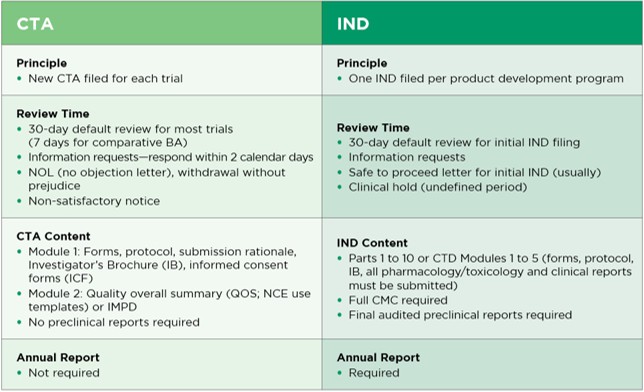
- Clinical Trial Application Review: Health Canada reviews the application typically within 30 days for phase 1-3 trials. Feedback is provided and a No Objection Letter (NOL) is issued when approved.
The CTA application itself is divided into 3 parts in accordance with the Common Technical Document (CTD) format:
- Module 1: Administrative and regional information
- Module 2: Quality (CMC), nonclinical, and clinical overview
- Module 3: Quality data (full CMC dossier)
After submitting a CTA, sponsors must respond to clarification requests within 2 calendar days. Once the submission is deemed complete, an acknowledgment letter is sent, confirming the start of the 30-day review period, or 7 days for comparative bioavailability studies. Additional clarification requests may be issued during this period. Health Canada guidance documents encompass this information in greater detail.
Detailed information on the structure of the CTA package can be found in section 2.3.2 of the Health Canada Guidance Document.
Clinical Trial Amendments
Health Canada also requires submissions in the form of a Clinical Trial Application-Amendment (CTA-A) or via a Notification if the sponsor makes protocol changes to a previously authorized CTA.
The level and scope of changes to the protocol dictate whether a full CTA-A or just a Notification is required. Please reference this guidance document for more information Clinical Trial Application – Amendments (CTA-As) – Canada.ca.
Applicable Health Canada Guidance Documents (Therapeutics)
|
Overview of the Clinical Trial Application Process – Canada.ca |
Health Canada: Overall summary of the CTA process |
|
Guidance Document For Clinical Trial Sponsors: Clinical Trial Applications – Canada.ca |
Health Canada: Guidance document for trial sponsors on CTA submissions |
|
Health Canada: Site Information Form |
|
|
Health Canada: Guidance document for submissions of Quality Overall Summaries in CTA applications |
|
|
Guidance document: The management of drug submissions and applications |
Health Canada: Guidance document for direction and guidance across a large scope of drug submissions and application types, including CTAs and New Drug Submissions (NDS) |
|
Health Canada: manual based on guidance documents for CTA applications, and provides tools and links for to facilitate CTA filing |
|
|
Health Canada: Guidance document for CTA applications of cell therapy products |
|
|
Guidance on procedures and administrative requirements for master files – Canada.ca |
Health Canada: Management of master files, including during clinical trials |
New Drug Submissions
Once clinical trials are complete and the drug’s benefits are greater than its risks, the sponsor will apply to Health Canada for market approval via a New Drug Submission (NDS). The NDS is filed with the Health Product and Food Branch (HPFB) of Health Canada, and the NDS must include:
- Relevant information and data on the drug’s safety, effectiveness and quality
- Results of all preclinical and clinical studies, whether done in Canada or elsewhere
- Details regarding the production, packaging, and labelling of the drug
- Information regarding the therapeutic claims and side effects
If the drug is approved, Health Canada will issue a Notice of Compliance (NOC) and a Drug Identification Number (DIN).
Note: Health Canada is currently undergoing modernizing efforts which include the submission requirements for biosimilar biologic drugs. Visit Health Canada’s website to learn more.
FDA Investigational New Drug Applications
An Investigational New Drug (IND) application is a request for authorization from the FDA to administer an investigational drug to humans and is necessary for sponsors who plan to conduct clinical trials in the US.
An IND enables sponsors to legally ship an investigational drug into the US to begin clinical trials. The FDA review time for an initial IND filing is 30 days. An IND can fall into one of two broad categories: a Commercial IND or a Research IND. Under each type, there are three categories of IND:
- Traditional/Investigator IND
- Emergency Use IND
- Treatment IND
An IND may be submitted for one or more clinical trial phases; generally, one IND is submitted per product development program and encompasses all phases.
For more information on required content for an IND, please visit the Code of Federal Regulations.
For assistance in navigating and preparing a FDA IND submission, please connect with provincial supports such as:
Applied Pharmaceutical Innovation
For a comprehensive collection of provincial regulatory, quality, funding, commercialization, and development supports for innovators, please utilize the Alberta Assets tool.
Protocol Amendments & INDs
Protocol amendments are required when changes are made to studies already covered under an IND. There are 2 main scenarios:
- New Protocols: this type of protocol amendment is required when a sponsor plans to conduct a study that was not previously included in the initial IND. The new study may only begin after the protocol is submitted to the FDA for review and is approved by the IRB (can occur in either order).
- Changes to Existing Protocols: in line with CTA-As, protocol amendments must be submitted to the FDA when changes significantly affect subject safety, scope of investigations, or scientific quality of the study compared to the original protocol.
CTA vs. IND
EMA & EU Clinical Trials Regulation: CTIS Submissions
A Clinical Trials Information System (CTIS) submission is the process of submitting a clinical trial application through the EU to obtain authorization for conducting a trial in EU/EAA countries. The CTIS supports interactions between sponsors and regulatory authorities in the EU Member States and EAA countries.
There are two parts to a CTIS submission: Part 1 is a scientific review, while Part 2 is an ethical and national level review. The total timeline for a CTIS submission can range from 60-106 days, with Parts 1 and 2 reviewed concurrently. Below is a further comparison between Parts 1 & 2:
| Part 1 (Scientific and Regulatory) | Part 2 (Ethics and National Considerations) | |
|---|---|---|
| Conducted by | Reporting Member State (RMS) | Each Concerned Member State (CMS), individual assessments |
| Review Scope | Study design, quality, IMP | Ethics, informed consent, patient safety |
| Main Documents | Protocol, IB, GMP, risk assessment | ICF, recruitment strategy |
| Outcome | Joint decision across all Member States | Individual decision per Member State |
| If rejected | Trial cannot proceed in any Member State | If rejected in a single Member State, can proceed elsewhere |
Key Differences Across EU, US and Canada
Although the EMA, FDA and HC are harmonized under ICH guidance, the 3 regulators have processes that diverge and can impact your clinical development strategy. Early regulatory strategy affects time‑to‑FIH, cost, and global development flexibility.
Health Canada | European Medicines Agency | FDA |
Fast, predictable 30‑day default review (as short as 7 days for some studies such as single-dose BA/BE studies)
| 60–106-day timeline for approval, strict clarification process | 30‑day IND review |
Lower translation burden, which reduces cost | Single submission via CTIS enables access to up to 30 EU/EEA countries
| IRB interactions managed by investigators, not sponsors |
IRB interactions managed by investigators, not sponsors; | CTIS submission has a Part I assessment & Part II assessment, can be submitted in parallel or consecutively
| Later‑phase US trials required for US market approval (must include US patient populations) |
Pre-CTA meeting available | Ethics review is required, arranged by member states and done in accordance with law of each member state | Pre-IND meeting available |
Attractive for early‑phase and first‑in‑human (FIH) trials | Longer and less flexible timelines; higher administrative complexity due to translation requirements for each member state |
|
What SMEs should consider:
- Early‑phase data generated under any region’s GCP‑compliant system is mutually admissible
- Canada often offers a fast, lower‑burden path to FIH
- Global programs still require regional trials for local market authorization
Summary:
Canada is often optimal for early clinical development, the US is essential for commercialization, and the EU-EMA enables multi-country access, at the cost of time and complexity.
For support in other global jurisdictions, please contact the Trade Commissioners Office.
Beyond Regulatory Requirements
In this step:
Study Design and Protocol Development
A study protocol describes in detail the plan for your study including the objectives, study design, methodology, data management and analysis plan, timelines and budget.
Complete outlines of study designs and trial protocols are required for pre-CTA, pre-ITA and Q-submission meetings with regulatory authorities. At this stage, it is critical to consider the number of participants required and where they will be enrolled. The SPIRIT-CONSORT guidelines are a useful tool that outline standard protocol items in interventional clinical trials.
There are numerous clinical trial design and protocol development services available to Alberta-based innovators. Connect with the Alberta Assets tool for more information.
Intellectual Property Considerations
Often the cornerstone of a company’s value, IP is typically protected through patent, copyright, or trademark applications, although the necessity and cost-effectiveness of such protection can vary.
It’s advisable for innovators to develop a structured IP strategy to guide future business decisions, including the timing of IP protection efforts. If you are within an Alberta institution, connect with your appropriate innovation offices to discuss protecting your innovation and developing a robust business strategy.
There are numerous IP supports and services available to Alberta-based innovators. Connect with the Alberta Assets tool for more information.
In addition, Alberta Innovates has published an applicable Health Innovation Roadmap that outlines key milestones in different domains along the development and commercialization journey, including IP milestones.
Clinical Trial Funding
Please utilize the Alberta Assets tool for a comprehensive list of clinical trial funding opportunities for both academic and non-academic innovators.
Health System Adoption
Although understanding the regulatory pathway for your innovation is critical, success also depends on adoption of your innovation within the health system. Clinical evidence alone isn’t sufficient for health system adoption. Important considerations include:
Define the system problem and fit: Clearly define the care or evidence gap, impacted population, current standard of care, and how the technology aligns with the provincial health agency priorities.
Value and affordability: Decision makers will look for evidence of improved outcomes, quality, access, provider experience, efficiency, cost savings, cost avoidance, or return on investment.
Identify the right health system partners: Engage clinical champions, operational sponsors, patients/families, procurement advisors, and the relevant provincial health agency.
Build the adoption evidence package: Combine clinical trial evidence with health economic analyses, real-world evidence, usability, workflow fit, implementation evidence and outcomes that matter to local decision makers.
Test in a real-world setting: Pursue a pragmatic or pilot trial, implementation study, or health evidence review to demonstrate feasibility, impact, safety, and value in Alberta care settings.
Implementation readiness: Adoption depends on fit with clinical workflows, staffing, training, change management, service delivery models, maintenance, and support.
Please refer to the Health Innovation Roadmap provided by Alberta Innovates. This roadmap outlines key milestones, including considerations for health system adoption and product-market fit.
Connect with the Health System Innovation and Partnerships team at Alberta Innovates for assistance with health system adoption.
Ready to Run Your Clinical Trial?
In this step:
CROs and Vendors
Are you ready to run your clinical trial? It’s time to think about CROs and vendors.
What is a Contract Research Organization (CRO)?
A CRO provides outsourced research and clinical trial services to clinical trial sponsors, including start-ups. These services can be all or a part of the clinical trial process, such as:
- Preclinical studies
- Regulatory strategy and regulatory submissions
- Quality management and ICH-GCP compliance
- Site selection, study start-up, study monitoring and study close-out
- Clinical trial management, ethics submissions, safety reporting, record keeping, DSMBs, overall data management
- Post-market surveillance
What is a clinical trial vendor?
A vendor is a service provider that specializes in a specific area of clinical trial operations, such as central labs, training, or translation services. Vendors can be contracted by the sponsor to perform their designated services or may be hired directly by the CRO. Sometimes, vendors are embedded into the CRO teams.
Clinical Trial Offices & Support Services
Academic innovators and SMEs not affiliated with an institution can access the support services from the U of A and U of C clinical trial offices (CTOs). The CTOs can assess readiness and help review what clinical trial services are needed and directly offer services; they can also assist with a general strategy, including assistance with vendor selection.
Alberta-based supports and services such as Applied Pharmaceutical Innovation or IMPACT Regulatory and Clinical Development can offer consultancy to determine what CRO services you need, what capabilities you have in-house, and compare against what they can offer as a CRO or what other provincial supports can offer.
Reach out to Clinical Trials Alberta for additional support and guidance along your clinical trial journey.